Tuesday, February 17, 2015

What Do You Know About Red Wine?

Wine has a long history of as a safe alternative to drinking water, an antiseptic for treating wounds, a digestive aid, and a cure for a wide range of ailments including lethargy, diarrhea, and pain from child birth. I probably don't need to convince you to drink more, so let's go ahead and continue our education to learn more about red wine.

Two well-known French red wines are Cabernet Sauvignon and Pinot noir.


Cabernet Sauvignons are typically full-bodied, high-tannin (tannins are the cause of the dry feeling in your mouth after you drink some wines), acidic wines. Cabernet Sauvignon wines have flavor combinations like blackcurrant and green bell pepper, blackcurrant and black cherry, blackcurrant and black olives, mint and ceda, eucalyptus, and menthol. Some Cabernet Sauvignons can taste very sweet, almost jam-like. 


I wouldn't recommend drinking Cabernet Sauvignons with high alcohol levels with spicy foods like chili peppers because the heat would accentuate the bitterness of the tannins. Milder spices, such as black pepper, pair better: they can minimize the tannins. That's why you see such classic pairings of Cabernet Sauvignon with steak au poivre (pepper steak) and pepper-crusted ahi tuna. Cabernet Sauvignon also complements dishes with a heavy butter cream sauce well.


Pinot noir is widely considered as one of the finest wines in the world. Joel Fleischman of Vanity Fair describes it as "the most romantic of wines, with so voluptuous a perfume, so sweet an edge, and so powerful a punch that, like falling in love, they make the blood run hot and the soul wax embarrassingly poetic."


Pinot noir comes in a broad range of bouquets, flavors, textures and impressions. Generally speaking, it has a light to medium body. You will find it can have an aroma reminiscent of black cherry, red cherry, raspberry, currant, and other small red and black berry fruits. Pinots also come with favors of tomato leaf, beet root, pale cherry, blackberry, cola, and plum.


You should drink fruity Pinot noirs with fatty fish like salmon, roasted chicken, and pasta dishes. Pinots with higher tannins go well with game birds like duck, casseroles, and stews like beef bourguignon (beef Burgundy, a stew prepared with beef braised in red wine and beef broth, generally with garlic, onions and a bundle of herbs, with pearl onions and mushrooms).


Stay tuned for a list of wine and food pairings!

Friday, February 13, 2015

Happy Valentine's Day!


Valentine's Day is tomorrow! Go celebrate with your chéri(e), doudou, petit coeur, petit chou or anything and everything of the like. Even if you don't have anything of the like, you can still go celebrate. Maybe go ice skating, bake a cake, or, I don't know, take a French class at the Alliance Française? Or you could do nothing, that's fine too. You don't have to be very into Valentine's Day.


For those of you who want to get in the Valentine's Day mood, however, this a blog post for you.


France is a traditionally Catholic country, so the country celebrates the holiday like any other western country. However, in France, Valentine's Day is known simply as "Saint Valentin," and to wish someone a happy Valentine's Day, you say joyeuse Saint-Valentin!


For those who weren't aware, the holiday was named for Saint Valentine. Not much is known about this Roman saint, but there are a ton of romanticized accounts about his life. One popular story is that Saint Valentine was imprisoned for performing weddings for soldiers who were forbidden to marry. During his imprisonment, he healed the daughter of his jailer and before his execution, he wrote her a letter signed "Your Valentine" as a farewell.


Regardless, of what Saint Valentine did with his life, we still love to celebrate love in his name. So, to commemorate the holiday, here's a list of fun Valentine's Day superstitions for your pleasure.


Some believe that the kind of bird a girl watches on Valentine's Day predicts her future husband. A sparrow means she will marry a poor man; an owl means she'll stay single; a bluebird means a happy man; a blackbird, a priest or clergyman; a goldfinch, a millionaire; a robin, a crime fighter; and a crossbill, an argumentative man.

If an apple is cut in half, the number of seeds found inside the fruit will indicate the number of children that individual will have.

To be awoken by a kiss on Valentine's Day is considered lucky.

The first guy's name you read in the paper or hear on the TV or radio will be the name of the man you will marry.

If you see a squirrel on Valentine's Day, you will marry a cheapskate who will hoard all your money.

If you see a flock of doves on Valentine's Day, you will have a happy, peaceful marriage.

If you find a glove on the road on Valentine's Day, your future beloved will have the other missing glove.


Whether or not these things happen to you, I hope you enjoy your day nevertheless. Joyeuse Saint-Valentin!

Tuesday, February 10, 2015

What Do You Know About White Wine?

Choosing, tasting, smelling--people have made consuming wine an art form. Unfortunately, most of us are far from artists. So, let's look at the basics of white wine.


White wine is often more refreshing and lighter than red wine. Many restaurants and people use white wine as an Apéritif--a drink, usually alcoholic, before a meal. However, they're also served during meals, with dessert, or as a refreshing drink between meals. Because of its light taste, white wine is perfect for summer and spring occasions.

Chardonnay and Sauvignon blanc are two particularly well-known French-originated white wines.


Chardonnay is probably the most versatile and well-known of the white wines. You can find Chardonnay with flavors of green apple, plum, citrus, pineapple, peach, melon and papaya flavors. Some Chardonnays are also smokey.


Because Chardonnay can be so diverse, you can pair it with a variety of foods. However, many drink it with white meats: turkey, roast chicken, etc. I would recommend pairing heavily oak influenced Chardonnays with smoked fish, spicy southeast Asian cuisine, garlic and guacamole dips. More acidic Chardonnays go well with tomato-based dishes and dishes with sweet onions. Older, more mellow Chardonnays taste great with more earthy dishes like mushroom soup and aged cheese.


Wine experts have used the phrase "crisp, elegant, and fresh" to describe Sauvignon blanc. Unlike Chardonnay, Sauvignon blanc has distinct and precise aromas and flavors--you can identify this wine much more easily.

The wine's flavor ranges from aggressively grassy to sweetly tropical. If you get a chance to smell this wine, you might get hints of grapefruit, lemon, melon, grass, herbs, vanilla, spices, or smoke, depending on the wine. Sauvignon pairs well with fish, cheese, and, surprisingly, sushi.

Stay tuned for a post about red wine!


Friday, February 6, 2015

Put Some Sweetness in Your Life; Have a Madeleine!


"No sooner had the warm liquid mixed with the crumbs touched my palate than a shudder ran through me and I stopped, intent upon the extraordinary thing that was happening to me. An exquisite pleasure had invaded my senses, something isolated, detached, with no suggestion of its origin."

It is with these words that Marcel Proust's sensory-filled, body-enveloping account, describes the taste of madeleine in his work, À la recherche du temps perdu (In Search of Lost Time) . 


Madeleines are delicious, spongy cakes with a distinctive seashell look. Most think the namesake of these treats is Madeleine Paulmier, but some disagree on who she was. Some say that she was a pastry chef in the 19th century; some say she was a cook for Stanislaw Leszczyński in the 18th century and that Leszczyński's son-in-law, Louis XV of France, named madeleines for Madeleine.

In any case, madeleines are classic representatives of French cuisine. Traditional recipes typically include finely ground nuts, usually almonds. Some recipes add in a little bit of lemon zest to add another dimension of taste to the cookies.

Nowadays, madeleines are not only found in France. The English are known for coating the cookies in jam and coconut, topped with a glacé cherry. Americans are known for mass-producing everything, including madeleines, and distributing them in plastic containers at your local Costco or Safeway.

Given their widespread presence, you've probably had the chance to taste these delectable cookies. If not, here is a recipe (found at thekitchn.com) to enjoy them at home. Perhaps the crumbs of the cookie will make a shudder run through you, too.

How to Make Classic French Madeleines 

Makes 24 madeleines (extracted from www.thekitchn.com)
What You Need
Ingredients

4 oz (1 stick), plus 3 tablespoons unsalted butter 

2/3 cup white sugar
1 cup all-purpose flour, plus 1 tablespoon, divided
2 large eggs
1 teaspoon vanilla
Pinch of salt
1 tablespoon lemon juice
1 tablespoon lemon zest
Powdered sugar (optional)

Equipment

Small sauce pan
Small bowl
2 medium-sized mixing bowls
Measuring cups and spoons
Whisk
Spatula
2 madeleine pans
Pastry brush
Small sieve for dusting with powdered sugar, optional

Instructions

  1. Melt the butter. Melt the butter in a small sauce pan. If you feel you can get it slightly toasty brown, go right ahead and do so by leaving it to bubble in the pan until it smells toasty and starts to color. Just remember that the butter will turn very quickly from toasty to burnt and that it will continue to color after it is off the heat unless you pour it into a new container. Spoon 3 tablespoons of butter into a small bowl or cup and set aside. Let the rest of the butter cool slightly.
  2. Prepare the dry ingredients and the wet ingredients in separate bowls. In a medium bowl, whisk together one cup of the flour and the sugar, and set aside. In another medium bowl, whisk the two eggs with the vanilla, salt, lemon juice, and lemon zest until the eggs are frothy.
  3. Combine the dry and wet ingredients. Add the eggs to the flour. Using a spatula, stir until just combined. Add the 4 ounces of melted butter and continue to stir. It may take a minute for the butter to blend into the mixture but do not over mix.
  4. Rest the batter. Cover the bowl with a plate (or plastic wrap) and place in the refrigerator to rest at least one hour and up to overnight.
  5. Prepare the pans. Add the remaining one tablespoon of flour to the 3 tablespoons reserved butter and stir to combine. Using a pastry brush, brush the interiors of the shells with the butter-flour mixture so that they are well coated. Place the pans in the freezer for at least an hour.
  6. Preheat the oven and fill pans. Preheat the oven to 350°F. Remove the batter from the refrigerator and one pan from the freezer. Fill each well in the madeleine pan with 1 tablespoon of the batter. Remove the other pan and fill in the same way.
  7. Bake the madeleines. Place both pans on a baking sheet for easy handling and place in the oven. Check after 8 minutes and rotate plans. Check again 5 minutes later. The madeleines should be browning around the edges and puffed up a little in the middle. Using your forefinger, press lightly on the center hump -- when the madeleines are finished baking, it should spring back at your touch.
  8. Cool and dust with sugar. Remove the madeleines from the oven and let cool for 2 minutes. Using a fork, gently loosen the madeleines from their molds and then tip the whole pan out onto a cooling wrack or tea towel. Once cool, dust lightly with powdered sugar and serve. If you are freezing or storing the madeleines, do not dust with the sugar until you are about to serve.
  9. To store. Store cooled madeleines in an airtight container for a few days or freeze them in a double wrapping of plastic wrap for several months. Let the cakes defrost before dusting with sugar.

Friday, January 30, 2015

"Je suis, tu es, nous sommes, ils/elles sont Charlie"

Par  Jean Eberhard, depuis Lyon, France.

Illustration  de Plantu publiée dans le numéro 294 jan./févr. 2015  
du Magazine des Adhérents de la Mutuelle Générale de 
l’Education Nationale. 
Le 7 janvier 2015, aux environs de midi, douze personnes dont huit journalistes et deux policiers, sont assassinées à Paris, dans une attaque contre le journal satirique « Charlie Hebdo ». Ces ignobles exécutions sont perpétrés par deux hommes criant « Allah akbar ».
Une cellule de crise, dirigée par le Président François Hollande et plusieurs membres du gouvernement, lance une chasse à l’homme…

Spontanément dans toute la France des dizaines de milliers d’hommes et de femmes se réunissent sur les places principales des grandes villes. A Lyon, ils sont plus de 15 000 à se rassembler, place des Terreaux devant l’Hôtel de Ville, mines graves, yeux rougis, abasourdis et  horrifiés par l’attentat.  Stylos ou lumignons brandis en l’air, ils crient  « Charlie », « Charlie » et des « Nous sommes Charlie ».

Le lendemain, le jeudi 8 janvier, une jeune policière municipale de la ville de Montrouge est abattue alors qu’elle participe à la gestion d’un banal accident sur la voie publique.
Le vendredi 9 janvier, quatre clients et employés d’un Super Marché Kasher, Porte de Vincennes, à Paris, sont exécutées par le même homme qui se revendique du groupe Etat islamique.
17 victimes en 3 jours exécutées au fusil mitrailleur ! 17 meurtres commis par 3 gamins de France, fanatisés et devenus terroristes tueurs !
Tous trois seront abattus par les policiers du « Raid » et du « GIGN » ce même 9 janvier, vers 17 heures.

La France est sous le choc !
Dimanche 11 janvier,  plus de 3 millions et demi de citoyens marchent en silence dans les villes et villages. Un silence assourdissant. A Lyon, les 15 000 du 7 janvier sont devenus 300 000, le dimanche !
40 chefs d’Etat étrangers répondent à l’invitation du Président Hollande et se joignent à lui pour défiler avec le peuple français, représenté par plus de 1,5 millions de citoyens.
Pas de mot d’ordre pour cette mobilisation générale qui traduit l’intensité de l’émotion. Mais un murmure insistant autour des mots « liberté », « égalité », « fraternité » et/ou de « Oui, à la démocratie. Non, à la barbarie ».

Un tel rassemblement est une première dans l’Histoire. Il traduit la détermination de la population française contre l’islamisme fanatique et son attachement  au respect de l’article 11 de la Déclaration des Droits de l’Homme et du Citoyen de 1789 :

« La libre communication des pensées et des opinions est un des droits les plus précieux de l’Homme : tout Citoyen peut donc parler, écrire, imprimer librement, sauf à répondre de l’abus de cette liberté dans les cas déterminés par la Loi »

Friday, January 23, 2015

Voulez-vous "slammer" avec moi maintenant?

Source Wikipedia


Vous vous sentez l’âme d’un poète, mais vous n’avez ni le génie d’Arthur Rimbaud, ni le talent de Victor Hugo. Pourquoi ne pas vous essayer au slam ?

Le slam est un art oratoire et un mouvement artistique qui consiste à déclamer des textes poétiques devant une audience bon enfant. Né aux USA, le slam n’a été popularisé en France qu'en 2006 avec le succès de l’artiste Grand Corps Malade.


Source Wikipedia


Les règles du slam étant très souples, tout un chacun peut s’y essayer au sein de soirées slam ouvertes  tous, à l’école ou entre amis.

Le (ou les) slammeur(s) ont trois minutes pour déclamer ou lire le texte poétique qu’il(s) doi(ven)t avoir écrit lui(eux)-même(s). Le texte peut être dit, lu, chanté, murmuré, ou même rappé. Et il n’est nul besoin de décors, de lumières ou de tenues vestimentaires spécifiques.


Source Wikipedia - The Moose

Les prestations peuvent éventuellement faire l’objet d’une évaluation et d’un vote par un jury composé de personnes choisies au hasard dans l’audience. Il existe aussi des tournois de slam où chacun peut improviser un texte, étant rappeler que l’objectif des prestations est de faire de la poésie, et non de gagner un tournoi. 

Dans certaines soirées slam, chaque texte dit est récompensé par un verre offert. Un joli moyen de mélanger l’art du langage et les traditions du partage. 

Tuesday, January 20, 2015

French in the World

Written by Diana Yen, UVA Student and Intern at the AFC.


“French” is typically connoted with France and our stereotypical, romantic ideas that come along with anything French—baguettes, pretentious behavior, thin mustaches, female armpit hair, black and white striped shirts accompanied with berets and maybe red ascots—but French is not only limited to France (and definitely not limited to any exaggerated stereotypes).


Flags of the Francophonie Members
FMLF 2012-3" by Serein -
CC - Wikimedia Commons


Many Americans are familiar with our northern neighbors speaking French, typically the Québécois dialect. Some know that French is also spoken in parts of Switzerland, Belgium, Senegal, and Cameroon. However, many Americans continue to feel that French is simply not as useful to know as a language as Spanish, Chinese, Arabic, and so on. They don’t think countries outside the aforementioned are familiar enough with French to make the language a tool in today’s globalized world. However, French is more widespread than many think.In Europe, France, Belgium, Monaco, Switzerland and Luxembourg all either list French as a native language or use France regularly.

In Africa, the countries that speak French are Algeria, Benin, Burkina Faso, Burundi, Cameroon, Central African Republic, Chad, Comoros, Democratic Republic of the Congo, Republic of the Congo, Côte d'Ivoire, Djibouti, Equatorial Guinea, Gabon, Guinea, Madagascar, Mali, Mauritius, Morocco, Niger, Réunion, Rwanda, Senegal, Seychelles, Togo, and Tunisia.

In the Americas and the Caribbean, Canada, French Guiana, Guadeloupe, Haiti, and Martinique speak French. In Australia and the Pacifics, French Polynesia, New Caledonia, and Vanuatu speak French.


So take a French class today!
"Map-Francophonie organisation fr" by Bourrichon - Licensed under Public Domain via Wikimedia Commons 

Friday, January 16, 2015

A Penny for Your Thoughts

Written by Diana Yen, UVA Student & Intern at the AFC.


French and English aren’t so different. We hear words and phrases like “rendez-vous,” “façade,” and “je ne sais quoi” on TV, in magazines, in books, and in everyday conversations. Some French words have been so seamlessly integrated into our vocabulary that we don’t blink twice when we hear those distinctly nasally pronunciations. 

Even the meaning of some idiomatic phrases carries over from French to English and vise versa. For instance, a common idiomatic French phrase is “sur le bout de la langue,” which literally translates into “on the tip of the tongue.” Sound familiar?

Some other French idiomatic phrases that translate into English well include “advienne que pourra” (come what may), à cheval donné, on ne regarde pas les dents (don’t look a gift horse in the mouth, literally translated into “for a gift horse, one does not look at its teeth”), and “prendre le taureau par les cornes” (take the bull by its horns).

Similarly, the French have taken a liking to certain English words. Many French citizens say “le week-end,” in lieu (another French word) of “la fin de la semaine,” meaning the end of the week. Words like “le parking” and “l’email” are also borrowed from the English vocabulary


However, don’t expect a French person to understand “it’s raining cats and dogs.” Instead, try telling him/her “il pleut des cordes,” the French idiomatic equivalent meaning “it’s raining ropes.” If you want to ask “a penny for your thoughts,” try asking “à quoi penses-tu?” (à quoi pensez-vous if you don’t know the person that well). The French won’t understand why you’re offering money for their thoughts, so you’ll ask instead “what are you thinking?” If you don’t take my advice, you’ll be barking up the wrong tree, or as they say in France, “faire fausse route,” literally meaning you’re taking the wrong route.


The French also have some idioms that would confuse English-speakers, too. Here are a few:

  • A bon chat, bon rat (two can play that game, literally translated: for a good cat, a good rat).
  • Faire la tête (to sulk, literally translated: to do the head).
  • Avoir les dent longues (to be ambitious, literally translated: to have long teeth).
  • Faire la grasse matinée (to sleep in, literally translated: to do a fat morning).

Friday, January 9, 2015

Prendre des cours en français tout en restant chez soi n'a jamais été aussi facile!

(Mathieu Plourde (Mathplourde on Flickr) Source Wikipedia)

Prendre des cours en français tout en restant chez soi ? Vous en rêviez? Cela est désormais possible avec les MOOCs. 

Les MOOCs, ou “massive open online course”, offrent la possibilité de suivre des cours en langue française partout dans le monde par le simple biais d’une connexion internet. Ouverts à tous, ces cours couvrent des domaines aussi divers que le droit, l’informatique, l’économie, le management ou les sciences humaines. 

Reposant sur l’usage de vidéos, de lectures, et d’exercices, les MOOCs se caractérisent par leur interactivité. Les étudiants, professeurs et assistants peuvent effectivement communiquer ensemble et s’entraider. Ceci permet aux uns d’améliorer leur compréhension des cours, et aux autres d’accroître la qualité de leur enseignement. Didactiques, et souvent d’excellente qualité, ces cours sont susceptibles d’intéresser autant ceux qui veulent étendre leur culture générale, que ceux qui veulent développer de nouvelles compétences ou connaissances, éventuellement à des fins professionnelles. Il est même désormais possible d’obtenir des certificats de formation pour un prix souvent modique.

De nombreuses universités françaises, suisses et belges, de même que le Ministère français de l’Education, de l’enseignement supérieur et de la recherche (via le site France Université Numérique), offrent désormais des cours en français dans de très nombreux domaines. Vous pouvez aussi vous tournez vers des plateformes telles que Coursera ou l’Annuaire des MOOC Francophones. Alors, tous à vos écrans !


Tuesday, January 6, 2015

La galette des rois: une tradition ... à déguster !

(Photo by Infrogmation. Source Wikipédia).
 Partager la galette des rois est une véritable tradition en France. Selon certaines estimations, il s’en vendrait plus de 32 millions durant les quelques jours qui précèdent et suivent l’Epiphanie (le 6 janvier en France). Ce succès s’explique probablement par le fait que ce gâteau est à la fois bon et convivial. La galette des rois donne en effet l’occasion de «tirer les rois ». A la maison ou au travail, on partage la galette. Celui ou celle qui obtient la fève cachée dans le gâteau devient le roi ou la reine de la journée, et il peut porter la couronne fantaisie qui l'accompagne. 

Mais saviez-vous que la galette prend différents noms et formes selon les régions de France, et qu’on la retrouve aussi en dehors des frontières françaises?

Ainsi, au nord de la France, la galette des rois est faite de pâte feuilleté parfois fourrée à la frangipane (crème d'amandes), à la pomme ou au chocolat. 

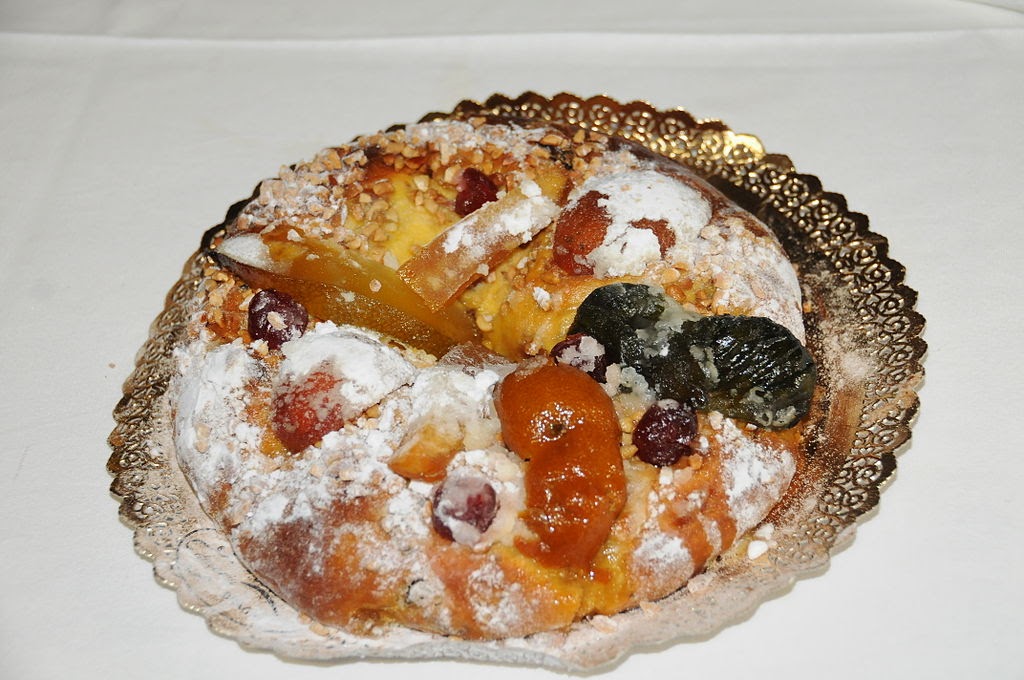
Au sud de la France, elle est appelée "gâteau des rois" et devient une couronne de brioche parfumée à la fleur d’oranger et décorée de fruits confits et de grains de sucre.

(Photo by David Monniaux. Source Wikipedia). 

Dans le Loiret, la variante locale est appelée Pithiviers. En Franche-Comté, on déguste la galette comtoise, dessert traditionnel à base de pâte à choux aromatisé à la fleur d'oranger. En Normandie, elle devient la Nourolle. 


Mais on retrouve aussi la galette des rois dans plusieurs pays d’Europe sous différentes formes. Elle s’appelle tortell en Catalogne, roscón en Espagne, bolo rei au Portugal, vassilopita en Grèce, et pitka en Bulgarie.
Bolo rei au Portugal (Photo José Conçalves. Source Wikipédia).


(Source Photo Wikipédia)

La galette des rois a même traversé l’Atlantique pour rejoindre le continent américain. Au Mexique, on l’appelle rosca

Aux USA, notamment en Louisiane, elle est devenu le King cake. Elle y prend la forme d’une couronne de brioche parfumée à la cannelle et décorée d’un glaçage de sucre coloré qui est mangée durant le Carnaval. 


(Source Photo Wikipédia)


Que vous la préfériez briochée ou faite de pâte feuilletée, n’hésitez pas à manger, voir même préparer vous-même une galette des rois! Voici d’ailleurs quelques recettes à essayer à base de pâte feuilletée, ou sous la forme d’une couronne des rois

Et surtout, n’oubliez pas la fève et la couronne qui vont avec!